Wishlist

Free shipping
In two business days

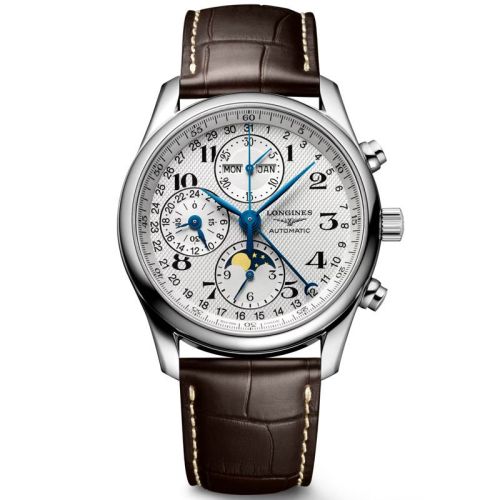
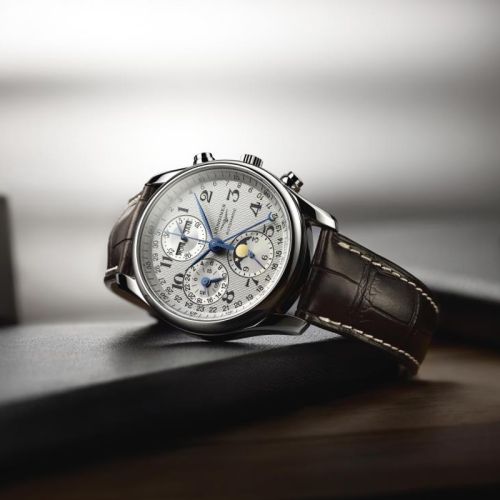
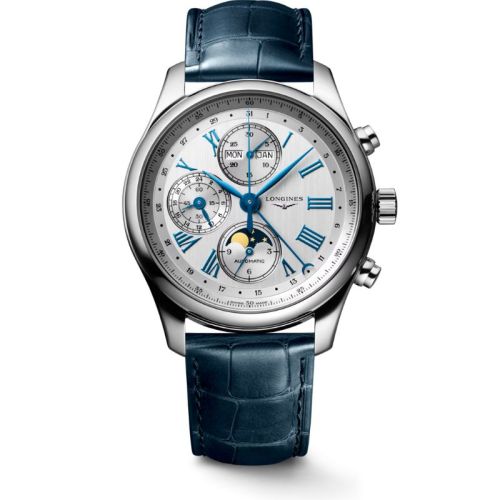
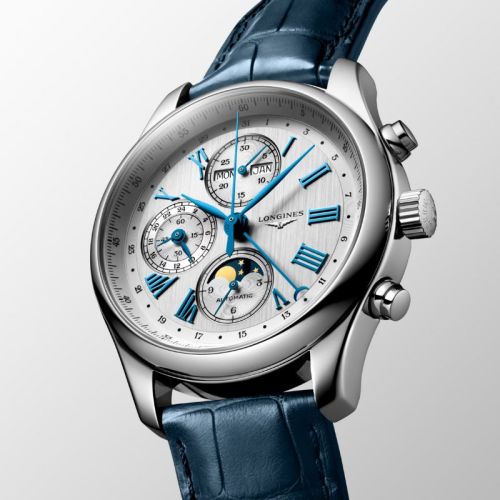
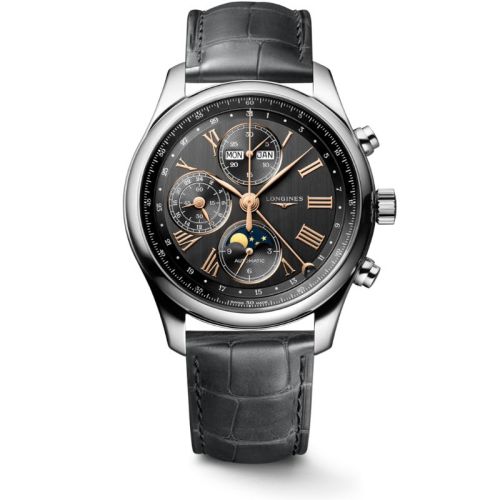
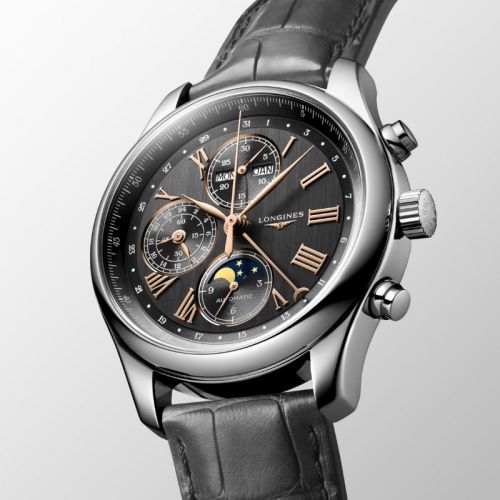
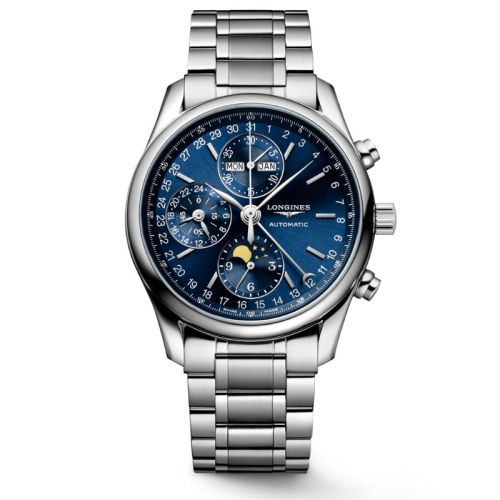
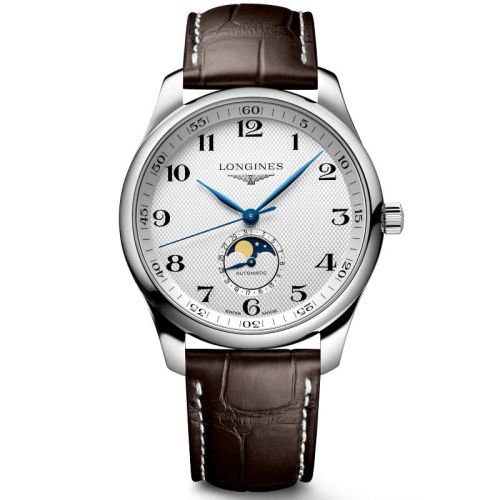
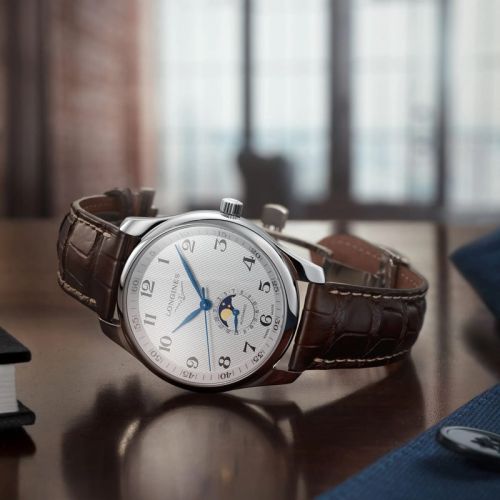
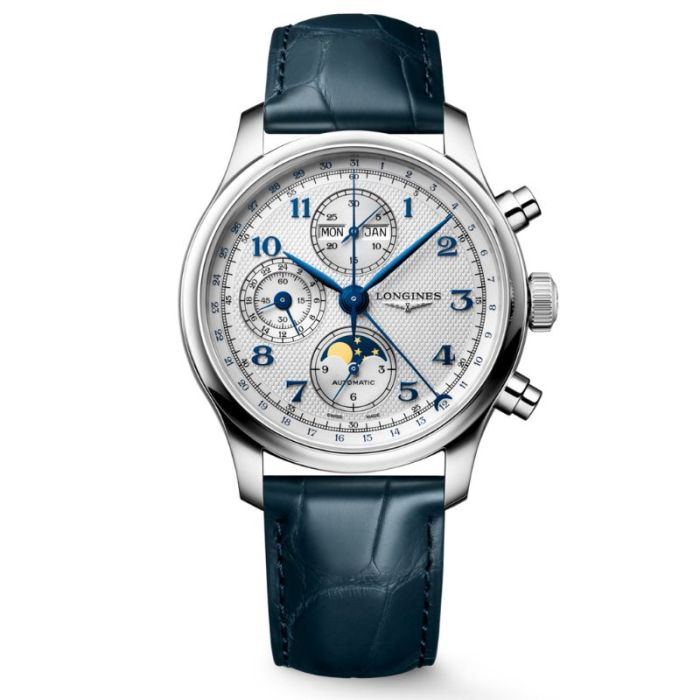
Longines Master Collection Chrono Moonphase 41 mm: complete calendar with day, month, pointer date and moonphase, column-wheel chronograph and L687.5 calibre with 66 hours of reserve. Silver barleycorn dial, blued hands and blue alligator strap. Six years of cover in Murcia.
 Case Size: 41 mm
 Movement: Longines Caliber L687
 Power reserve: 66 hours approx.
 Water Resistance: 30 meters
 Watch strap material: Leather
In two business days
By phone: +34 968 271 055 or by WhatsApp: +34 610 085 630
Credit card, Paypal or Payment in installments with Aplazame

In two business days

Phone: +34 968 271 055
WhatsApp: +34 610 085 630

Credit card, PayPal or pay in instalments with Aplazame
Worth starting here, because it is the most underrated thing about this watch. Beyond the chronograph and the moonphase, the dial shows the day of the week, the month, the date and the time in 24-hour format. That is five indications on top of the time, and the way they are fitted in is the elegant part. At 12 sits the chronograph's 30-minute counter, flanked by two apertures, one for the day and one for the month. At 6, a single subdial does two jobs: it is the chronograph's 12-hour counter and it houses the moonphase, a dark blue disc with a gold moon and stars beneath a shaped aperture. At 9, another subdial doubles up: running seconds and a 24-hour indicator. And the date is carried by a central hand tipped with a crescent that sweeps the periphery. Five indications across only three subdials, which is exactly what stops the dial looking like a dashboard.
This is the question nobody answers, and it has an arithmetic answer. A conventional moonphase drives its disc through a 59-tooth wheel, which fits two moons into 59 days and gives a cycle of 29 and a half days. The real lunar month, what astronomers call the synodic month, runs 29 days, 12 hours and 44 minutes. Those 44 minutes per cycle accumulate until they add up to a full day of drift after roughly two years and eight months. Put another way: set it correctly and wear it regularly, and the moon stays right for more than two straight years without being touched. Longines does not publish a drift figure for this particular calibre, so we give it for what it is, the arithmetic of the standard mechanism, not a manufacturer specification. If the watch stops and sits in a drawer for weeks, the correction has to be made anyway.
The first, and it is the important one: do not correct the calendar or the moonphase while the hands sit between seven in the evening and six in the morning. Through that window the mechanism already has the date-change wheels engaged, and forcing a correction through the pushers or the corrector can damage parts you will pay for later. That warning comes from Longines itself, not from us, and it is the most common cause of failure in calendar watches. Wind the hands forward to mid-morning and correct then, unhurried. The second: the chronograph pushers are pump-style, not screw-down, and this watch is rated to 3 bar. Three bar handles rain and splashes, never a shower or a pool, and pressing a pusher while the watch is wet is the quickest route to getting water inside. If it gets wet, dry it before touching anything.
Because a window would have cost two things that matter a great deal on this dial. First, a numeral: on the collection's models with a date window, the cut-out swallows the 3 o'clock marker and the dial is left with eleven numerals instead of twelve. Here all twelve are present, applied and in blue, and the symmetry stays intact. Second, surface: the barleycorn motif runs across the dial without a rectangular cut-out interrupting the pattern. In exchange, a pointer date reads less instantly than a window, you have to follow the crescent to the figure on the outer track, and that is the honest trade. It is the classic solution of the complete calendars of the mid twentieth century, and it was chosen then for the same reason as now: the dial looks better.
The blue on a set of steel hands can be achieved three ways, and they are not worth the same. The traditional route is thermal: the steel is heated to around 290 degrees and the oxide layer that forms on the surface produces the colour, so it is not paint but the metal itself transformed. The other two routes are chemical blueing and, further down, lacquer or coating. Longines describes these as blued steel hands without specifying the method, so we will not claim which it is. What can be said is how they behave: a well-made steel blue reads almost black under indoor light and lights up electric blue when the sun catches it from the side, and that shift is precisely what makes blue hands work over a silver dial. The applied Arabic numerals share the same blue and the subdials carry a snailed finish.
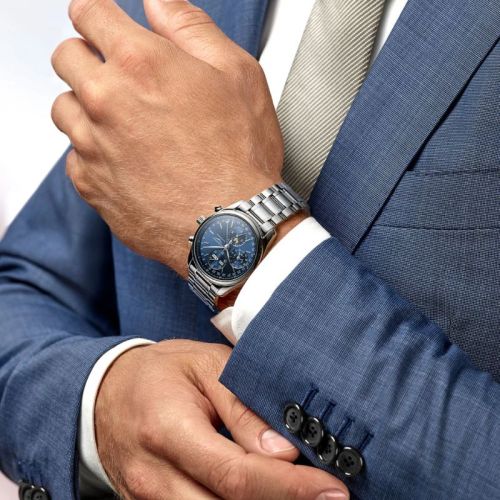
This is where the complication gets paid for, and it is worth knowing beforehand. The watch is 13.80 millimetres thick and weighs 103 grams. For context, the three-hand Master Collection at 41 millimetres, same steel case and also on a strap, is 9.50 millimetres and 78 grams. The difference, four millimetres and a good deal of presence, is literally the chronograph and calendar module. Lug to lug is 48.60 millimetres, practically identical to the simple model, so its footprint is the same: what changes is the height. Under a close-fitting shirt cuff you will notice. The 2026 generation has already worked on this, merging the old 40 and 42 millimetre cases into this single 41 and shaving the height down from the previous 14 millimetres. This is a suit and occasion watch before it is a daily office one.
The calibre is the L687.5, exclusive to Longines, beating at 28,800 vibrations per hour, 4 Hz, with 66 hours of reserve. The comparison with its three-hand sibling is instructive because the trade runs the other way: that one drops to 25,200 vibrations to reach 72 hours, while this one holds 28,800 and settles for 66. It makes sense, because a chronograph needs a high frequency to divide the second finely, and at 4 Hz the hand measures eighths of a second. The chronograph is controlled by a column wheel, the classic command system, costlier to make than a cam and cleaner under the finger. It carries 27 jewels, a free-sprung balance and a silicon balance spring, a material that does not magnetise and resists corrosion, though it is more brittle than steel under a sharp knock and, if damaged, is replaced rather than repaired. The sapphire case back shows the whole assembly.
Longines gives five years of international warranty on this reference. Pedro Luis Olivares Joyero adds a further year as an official Longines service centre, so the real cover is six years. The Spanish legal guarantee of conformity, three years since 2022 and applied automatically, is absorbed by being shorter. And with a calendar and moonphase module involved, that distinction matters more than on a three-hand watch: this is precisely the kind of mechanism you do not want in the hands of a general workshop. Outside the warranty there is one point worth being clear about: the strap is a consumable, not a fault, and when the time comes it is replaced here, without the watch leaving Murcia or spending weeks away. You will find us at Avenida Constitución, 4 and Gran Vía Escultor Salzillo, 15, holding the exclusive Longines distribution for the Region of Murcia.
| Reference | L2.962.4.73.2 |
|---|---|
| Collection | The Longines Master Collection Chrono Moonphase |
| Diameter | 41.00 mm |
| Thickness | 13.80 mm |
| Lug to lug | 48.60 mm |
| Lug width | 21 mm |
| Weight | 103.0 g |
| Case material | Stainless steel, round |
| Crystal | Sapphire with several anti-reflective layers on both sides |
| Case back | Transparent sapphire |
| Dial | Silver with "barleycorn" motif |
| Markers | Applied Arabic numerals |
| Hands | Blued steel |
| Calibre | L687.5, automatic, exclusive to Longines |
| Chronograph | Column wheel, 27 jewels |
| Frequency | 28,800 vibrations/hour (4 Hz) |
| Power reserve | Approximately 66 hours |
| Balance spring | Silicon, free-sprung balance |
| Functions | Hours, minutes, running seconds and 24-hour indicator at 9, pointer date with central crescent hand, day and month at 12, moonphase at 6 |
| Chronograph counters | 30 minutes at 12 and 12 hours at 6 |
| Water resistance | 3 bar (30 m) |
| Strap | Blue alligator leather, calf leather lining |
| Clasp | Triple folding safety clasp with push-piece opening and fine adjustment |
| Warranty | 5 years Longines + 1 year Pedro Luis Olivares Joyero |
| Price | 4.150 € |
|---|---|
| Price by range | 2.500 € - 5.000 € |
| Stock | In Stock |
| Gender | Male |
| Brand | Longines |
| Strap | Leather |
| Movement | Automatic |
| Movement | Longines Caliber L687 |
| Collection | The Longines Master Collection |
| Model | L2.962.4.73.2 |
| Cristal | Scratch-resistant sapphire crystal, with several layers of anti-reflective coating on both sides |
| Dial | Silver |
| Case material | Steel |
| Case size | 41 mm |
| Case size | Over 40 mm |
| Water Resistance | 30 meters |
| Water resistance | Up to 50 m |
| Power reserve | 66 hours approx. |
| Bracelet type | Leather |
| Clasp | triple safety folding clasp and push-piece opening mechanism with fine adjustment system |
| Function | Day-Date, Chronograph, Moon Phase |
| Warranty | 5 year international Longines warranty plus an additional year from our certified watchmaker. |