Wishlist


Free shipping
In two business days

 Case Size: 41 mm
 Movement: Breitling Calibre 32
 Power reserve: 42 horas aprox.
 Water Resistance: 50 meters
 Watch strap material: Leather
In two business days
By phone: +34 968 271 055 or by WhatsApp: +34 610 085 630
Credit card, Paypal or Payment in installments with Aplazame

In two business days

Phone: +34 968 271 055
WhatsApp: +34 610 085 630

Credit card, PayPal or pay in instalments with Aplazame
There are watch names that describe a function. And there are names that encapsulate an entire era. Navitimer, a contraction of "navigation" and "timer", was Willy Breitling's answer in 1952 to a specific request from the Aircraft Owners and Pilots Association (AOPA), the largest pilots' club in the world: create a wrist chronograph with which our pilots can perform all the flight calculations they need. The answer changed watchmaking history.
What Willy Breitling designed was, technically, the first analogue wrist computer in history. In the 1950s, commercial aircraft pilots used the E6B slide rule in the cockpit, a cardboard or metal instrument with circular logarithmic scales for calculating distances, speeds, fuel consumption, climb and descent rates, and unit conversions. Breitling adapted exactly those scales to a watch's rotating bezel and created the instrument that the AOPA adopted as their official watch in 1954, writing its name into history without knowing it.
In 1962, astronaut Scott Carpenter prepared for the Mercury mission with a Navitimer on his wrist. But he had a problem: in the darkness of space, he could not tell day from night. He asked Breitling for something that seemed impossible at the time: a Navitimer with a 24-hour dial. Breitling built it to order. On 24 May 1962, the Navitimer became the first Swiss wristwatch in space. From that moment on, no other watch in history can claim the same legacy without lying.
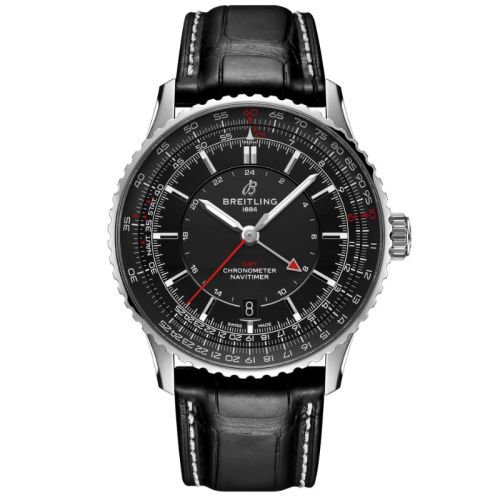
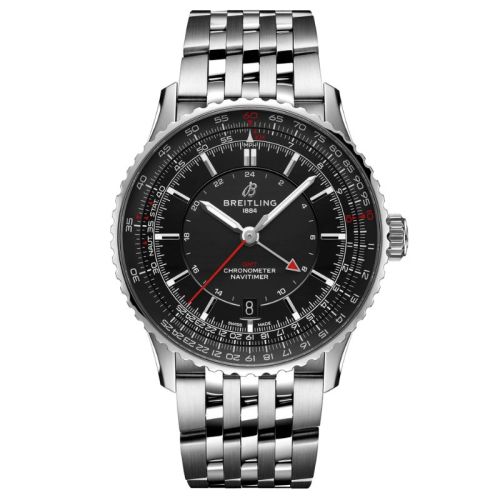
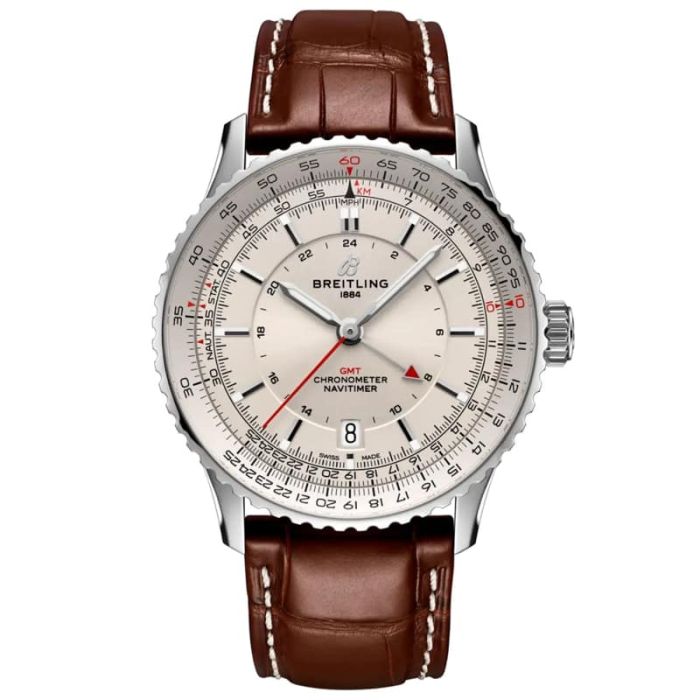
The Breitling Navitimer Automatic GMT A32310211G1P1 is the logical evolution of the Navitimer for the modern world: it preserves the bezel slide rule intact, the same one from 1952, functional and precise, and adds a second time zone via a central GMT hand and the 24-hour scale printed on the dial periphery. The central placement of this scale is the most immediate visual difference from the chronograph Navitimer: the dial is organised differently, with the 24-hour ring occupying the central space where the chronograph had its counters, resulting in a cleaner, more legible and more contemporary composition without losing a single millimetre of the model's historical character.
The GMT function of the A32310211G1P1 is of the caller GMT type: the 24-hour hand, lacquered in red for maximum visibility against the cream dial, rotates once every 24 hours over the perimetral scale, continuously and precisely indicating the second time zone. The fundamental difference from a classic GMT is the setting method: in the caller GMT, the GMT hand moves in one-hour increments independently from the main movement, meaning it can be adjusted without stopping the watch, without losing a single second of precision, and without needing to recalibrate the hours. Pull the crown to the first position, rotate forward and the GMT hand advances hour by hour. Backwards, it adjusts the date. It is one of the most pragmatic and well-considered GMT implementations on the market at this price level.
The logarithmic circular slide rule on the Navitimer bezel is not decoration. It is a genuine aerial navigation instrument that pilots of the 1950s and 60s used as their primary cockpit tool. On the A32310211G1P1, the bezel carries the engraved STAT (standard mileage), KM (kilometres) and NAUT (nautical miles) scales, along with the logarithmic values that enable analogue multiplication and division.
With the Navitimer slide rule, a pilot can calculate in seconds, with no electronic device whatsoever: average speed by dividing distance by time; distance covered by multiplying speed by time; remaining fuel consumption by cross-referencing hourly consumption with remaining flight time; climb or descent rate in feet per minute; and conversion between miles, kilometres and nautical miles via the bezel's conversion markers. In today's world, very few pilots use the slide rule: FMS flight management systems do everything automatically. But carrying on one's wrist the ability to perform those calculations autonomously, without batteries, without signal and without technological dependence, is precisely the argument that makes the Navitimer something more than a watch.
The notched bezel, the small perimetral protrusions that give the Navitimer its unmistakeable silhouette, was originally designed so that pilots could operate it wearing aviation gloves. On the A32310211G1P1, that bezel retains its historical form with a subtle update: the notching is slightly more contemporary, more ergonomic and more solid than the original 1950s version, but the silhouette is the same. It rotates with a precision and tactility that no smooth steel bezel can match.
The cream dial of the A32310211G1P1 is not a fashion choice. It is the most historically coherent choice within the Navitimer Automatic GMT 41 range. The Navitimers of the golden age of civil aviation, the 1950s, 60s and early 70s, featured dials in pale tones, ivory or cream, with silver or gold indices and hands that over the decades aged into the patinated tone collectors call "tropical" or "tropical cream". The current cream dial of the A32310211G1P1 recreates that tone from day one: a direct reference to the collector's Navitimers that can reach tens of thousands of euros at auction.
The dial is structured in three perfectly legible concentric rings: the outer slide rule ring (on the bezel, bidirectional), the perimetral 24-hour ring printed on the dial with 1-to-24 numerals in cream-on-cream tones, and the central minute ring with applied baton hour markers and the date window at 6 o'clock. The red GMT hand contrasts dramatically and effectively against the cream background, making the second time zone instantly readable even at a distance. The sword-style hands with luminous treatment and applied luminous markers guarantee full legibility in low-light conditions.
The Breitling Calibre 32 is the automatic movement equipping the Navitimer Automatic GMT 41. Based on the ETA 2893-2, Breitling has subjected this movement to its internal regulation and adjustment process to achieve COSC certification (Contrôle Officiel Suisse des Chronomètres), the most demanding independent precision certification body in Swiss watchmaking. To obtain COSC certification, a movement must maintain precision of between -4 and +6 seconds per day over 16 consecutive days in five positions and at three different temperatures. Only 3% of Swiss watches produced each year bear the COSC certification.
Exact technical data: 25.6 mm diameter, frequency of 28,800 vibrations per hour (8 Hz, double the standard frequency of classical watchmaking), 21 jewels, bidirectional automatic winding, 42-hour power reserve, date function and independently adjustable GMT hand without hacking the movement. The high 4 Hz frequency is a direct technical advantage for precision: the more time divisions per second, the more exact the movement's behaviour under changes in wrist position.
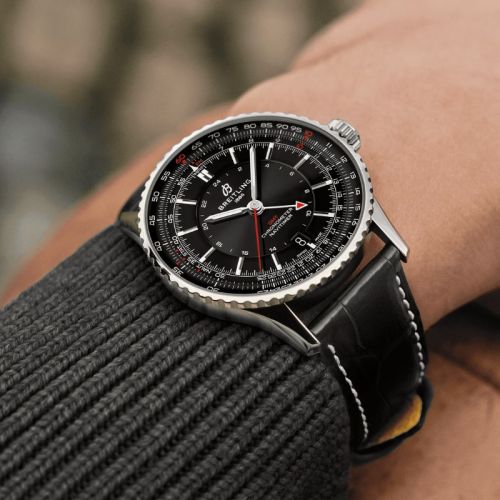
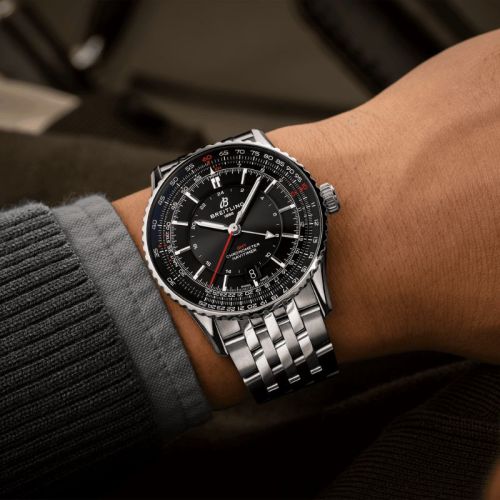
The 41 millimetres of diameter of the A32310211G1P1 are not arbitrary: they are the same 41 mm that Willy Breitling fixed in 1952 as the cockpit diameter for the original Navitimer. It was an unusually large diameter for the era, most 1950s watches measured between 34 and 36 mm, but Breitling justified it with an irrefutable argument: maximum legibility for in-flight use, where the pilot cannot take their eyes off the cockpit instruments to read their watch.
More than 70 years later, the 41 mm of the Navitimer GMT is exactly the right diameter for a contemporary aviation watch: present enough on the wrist for the slide rule bezel and three-ring dial to be completely legible, contained enough to fit under a shirt cuff and remain comfortable in everyday wear. The case combines satin-brushed finishes on the flanks and on the bezels and lugs, creating the interplay of reflections that characterises the Breitling visual identity. The 11.60 mm thickness is competent for an automatic GMT: moderate, elegant in wrist profile and coherent with the model's formal vocation.
At Pedro Luis Olivares Joyero, jewellery and watchmaking in Murcia since 1925, we are Official Breitling Retailers for the Murcia Region. The Breitling Navitimer Automatic GMT A32310211G1P1 is available in our boutiques with the official 2-year Breitling International Ltd. warranty, the certificate of authenticity and the original brand documentation.
Visit our boutiques at Avenida Constitucion, 4 and Gran Via Escultor Salzillo, 15 in Murcia, where our specialist team will show you in person how the slide rule works, how the GMT hand sets independently, and how the cream dial changes under different light sources. We also ship across Spain, Europe and the United Kingdom with secure delivery and transit insurance included.
Because some watches tell the time. And some watches tell a story. The Navitimer has been doing both from the same wrist for over 70 years.
| Specification | Detail |
|---|---|
| Reference | A32310211G1P1 |
| Collection | Breitling Navitimer Automatic GMT 41 |
| Case | Stainless steel, 41 mm diameter, 11.60 mm thickness, satin-brushed and polished finishes |
| Bezel | Bidirectional rotating, notched, with logarithmic circular slide rule (STAT, KM, NAUT scales) |
| Crystal | Anti-reflective sapphire |
| Case Back | Solid stainless steel |
| Crown | Push-pull (non-screw down) |
| Dial | Cream, central perimetral 24-hour scale, applied baton luminous hour markers, sword-style luminous hands, red GMT hand, date at 6 o'clock |
| Movement | Breitling Calibre 32, automatic, bidirectional winding, COSC-certified chronometer |
| Calibre Base | ETA 2893-2, regulated and adjusted by Breitling |
| Calibre Diameter | 25.6 mm |
| Frequency | 28,800 vph (4 Hz) |
| Jewels | 21 |
| Power Reserve | 42 hours |
| Functions | Hours, minutes, central seconds, second time zone GMT (independent caller hand), date |
| Lug Width | 20 mm |
| Strap | Matt brown alligator leather, stainless steel butterfly folding clasp |
| Water Resistance | 30 metres (3 bar) |
| Certification | COSC — Contrôle Officiel Suisse des Chronomètres |
| Warranty | 2 year official Breitling International Ltd. (non-manufacture movement) |
| Manufacture | Swiss Made |
| Price | 6.100 € |
|---|---|
| Price by range | 5.000 € - 10.000 € |
| Stock | Out of Stock |
| Gender | Male |
| Brand | Breitling |
| Strap | Leather |
| Movement | Automatic |
| Movement | Breitling Calibre 32 |
| Collection | Navitimer |
| Model | A32310211G1P1 |
| Cristal | Curved sapphire crystal, anti-reflective coating on both sides. |
| Dial | White |
| Case material | Steel |
| Case size | 41 mm |
| Case size | Over 40 mm |
| Water Resistance | 50 meters |
| Water resistance | Up to 50 m |
| Power reserve | 42 horas aprox. |
| Bracelet type | Strap |
| Clasp | Desplegable |
| Function | Calendar, GMT |
| Warranty | 2 year international warranty from Breitling plus an additional year from our certified watchmaker. |